Monday, September 6, 2010

Day 17: Denderah and Luxor Temple

During the night our boat sailed north from Luxor to Qena where we visited the Temple of Denderah in the morning. The temple was built for the Goddess Hathor, the goddess of pleasure and love represented as a woman with a cow’s head. Our guide told us that if an Egyptian man says, “You have the eyes of a cow,” it’s a great compliment – not an insult!

Denderah was another temple that made my jaw fall open! It was gorgeous with massive columns depicting the Goddess Hathor at the top and a roof that survived thousands of years. We were able to see the vibrant colors of the temple at the tops of the columns and half of the ceiling. Our guide explained that the archeologists have been working hard with special chemical processes to clean the temple and let the colors underneath a protective layer of dirt and sand show. The temple was so beautiful, despite the fact that the early Christians had chiseled away at all the carvings on the temple walls that were not hidden from harm under the sand. Our guide told us that he felt like crying when he imagined how spectacular the temple would be but for the defacing of many beautiful scenes.
Me at the entrance to Denderah Temple.
Us next to the entrance of Denderah Temple.
Looking at the inner temple from the courtyard.
Columns with the head of Hathor.
Pretty colors!
Half cleaned ceiling.
Paul at the sanatorium (hospital outside the temple).

We walked to the back of the temple and were able to visit one of the temple’s crypts. We walked down a few makeshift wooden stairs and shimmied through a tiny little whole in the wall. One girl in our group said if she had one more piece of pita bread at breakfast, she never would have made it! It was that small. The tiny hole in the wall opened up onto a long narrow corridor where the high priests hid gold and jewelry during ancient times.
Me in the crypts.
Scenes on the walls of the crypts.
Paul crawling out through the little entry way.
Me climbing up the rickety wooden stairs.

We spent the day getting lounging on the sun deck and swimming in the little plunge pool on the boat as we sailed back to Luxor. We saw lots of fisherman and children swimming in the water and shouting at our boat along the way. And based on a few gestures I saw, not all the children were friendly.
View from our boat.

Paul relaxing with a book as we sailed down the Nile.


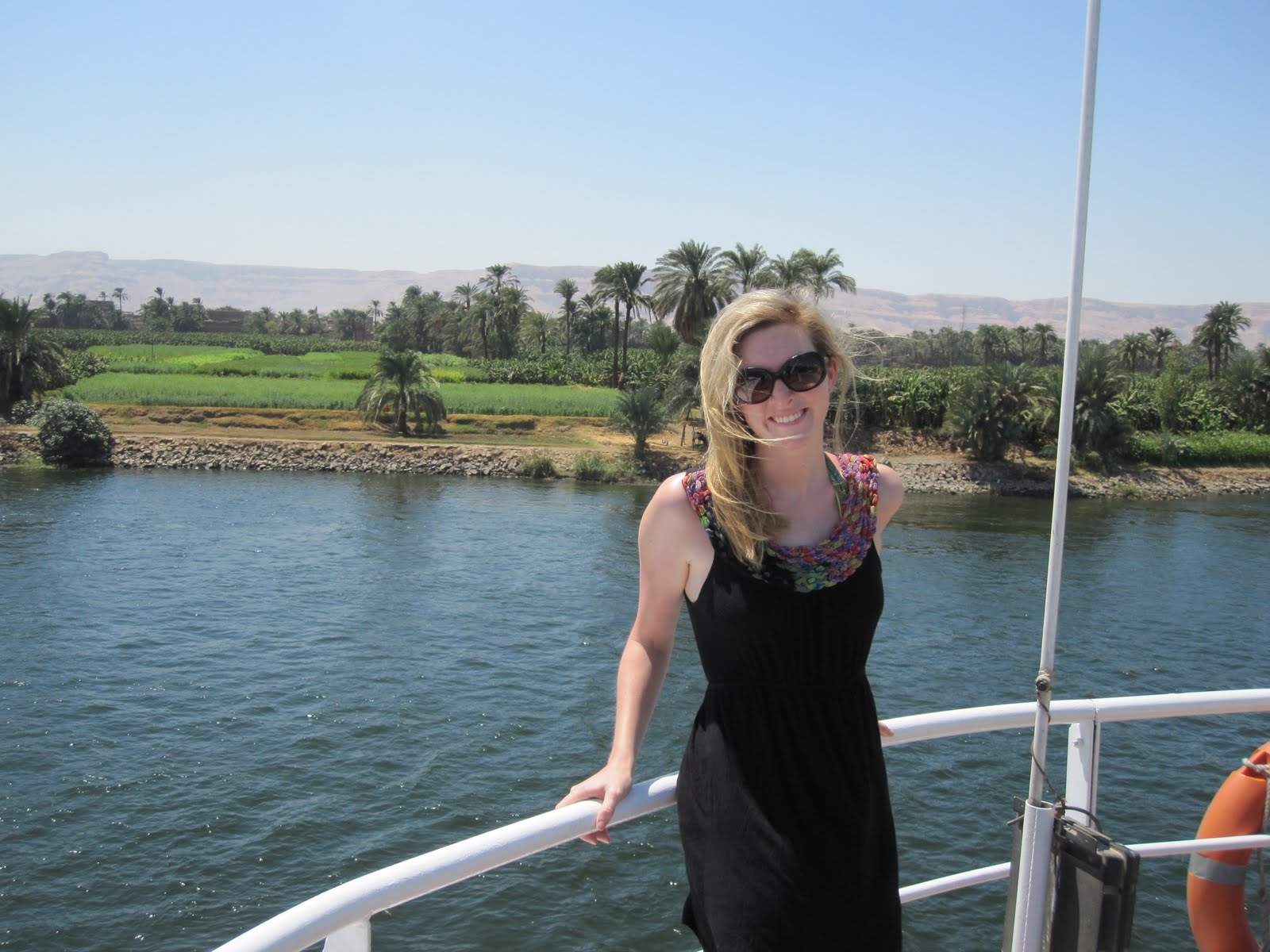
Me on the bow of our boat.

In the evening we visited the Temple of Luxor, all lit up at night, and saw the Avenue of Sphinxes that runs the 3 km from the Temple of Luxor to the Karnak Temple. There is also an “open air museum” at the Temple of Luxor that has what, at first glance, looks like a big collection of random stones. All of the stones have carvings and hieroglyphics and, our guide explained, the archeologists are currently attempting to fit the pieces together. It looks like the most frustrating jigsaw puzzle I have ever seen!
Us at the entry to Luxor Temple.
Columned entry with two statues of Ramses II.
Courtyard lit up at dusk.
Us in the courtyard.
Ramses II lit up at night.
Little Cleopatra 7 (of Cleopatra and Mark Antony fame) standing next to a massive statue.
Statue of King Tut and his queen.
Jigsaw puzzle.
The whole temple lit up at night!

We got back to the boat for another delicious dinner and then slept as we sailed up the Nile to our next destination.

Sunday, September 5, 2010

Day 16: Luxor

We woke up for our super early flight to Luxor to start our cruise down the Nile. A&K picked us up, had our plane tickets printed and waiting at the airport, and took us and our bags through security and to our gate. It was nice to not to worry about a single thing! After a delayed, hot, and generally uncomfortable flight, we arrived in Luxor and were delivered to our gorgeous boat. We were greeted with cold towels and cool hibiscus tea (which our Egyptologist assured me several times was a healthy drink – it tasted so good, I didn’t care!) and I quickly forgot the irritations of our flight. We were quickly checked into our cabin and hurried out to visit our first site in Luxor, Karnak Temple. WOAH!

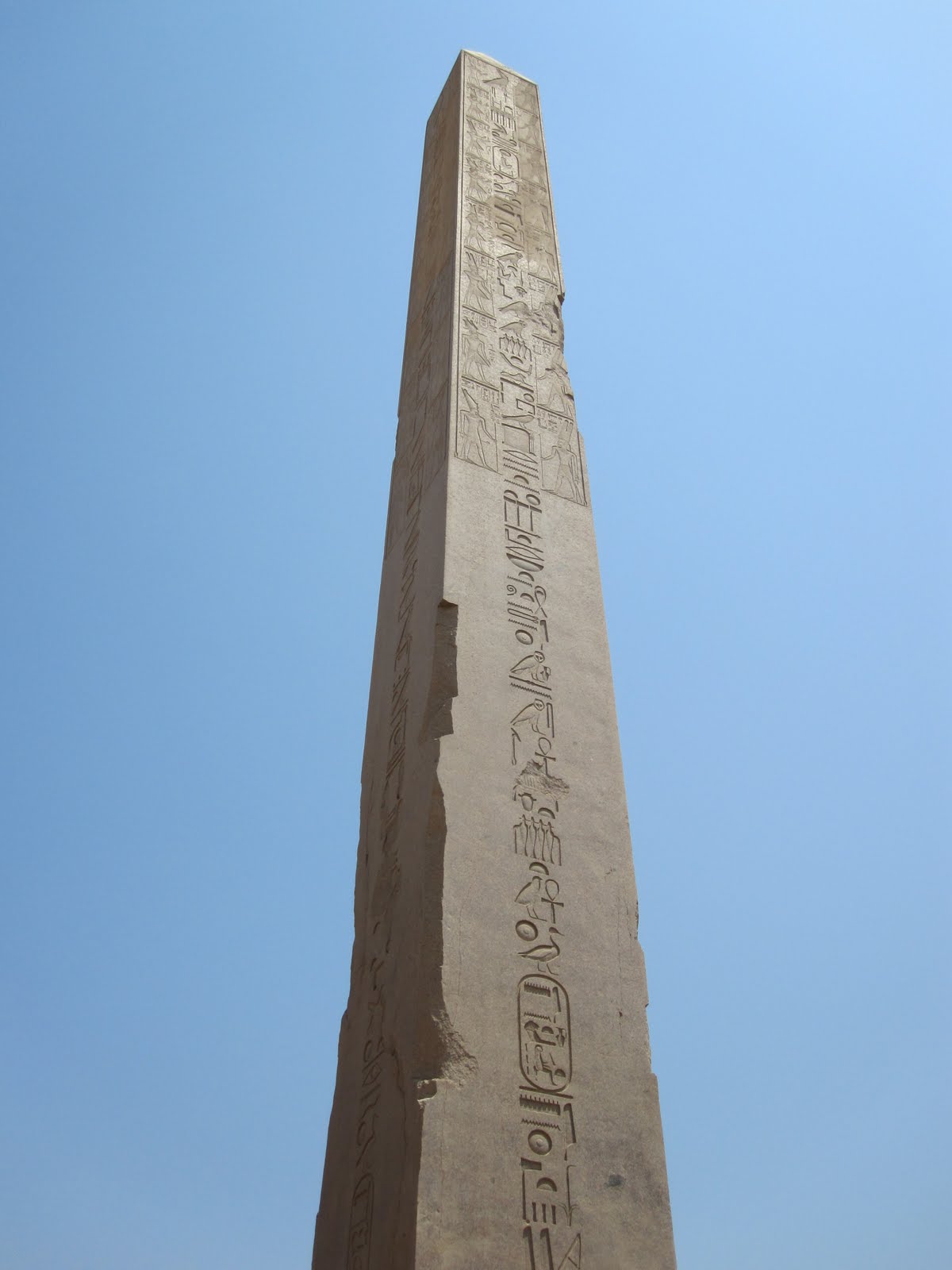
Paul thought the pyramids were not impressive after visiting Petra in Jordan. I disagreed. My way of looking at our visit was simply that the pyramids are completely different than Petra. There is no comparison. Each site is amazing in its own way. Well, after seeing Karnak Temple, I have to admit the pyramids are the least impressive site we have seen (although I still maintain the Great Pyramids were an amazing must-see!). I was in awe of Karnak Temple! My mouth was hanging open the entire time we looked at the big columns in the shape of papyrus flowers, the endless carvings of scenes and hieroglyphics, the colors on the walls, the obelisks extending up toward the sky, the small piece of the marble floor that was discovered. I can’t even begin to imagine how beautiful the temple was during the ancient times.

The entrance to the temple, with rows of ram headed sphinxes on either side (a symbol of the god Amun Ra).

Columns on columns - the upper set of columns framed the open windows in ancient times.

Paul standing in the columns.


Close up of the colorful ceiling.

Paul in front of an obelisk.

Me in front of statues holding the ankh (the key of life). The statues stood on either side of an alter at the end of a long room.

After lunch on the boat, we hopped onto a little motor boat and headed over to the Valley of the Kings and Valley of the Queens on the West Bank of the Nile. The tombs in the Valleys of the Kings and Queens were amazing. I thought the faded colors on the walls in the Temple of Karnak were impressive…Never mind. The colors in the tombs were breathtaking! It was like the tombs were painted yesterday, with vibrant white backgrounds and bright reds and yellows and blues (sadly no pictures). We learned that there is a tomb in the Valley of the Queens that is so gorgeous the cost of entry is $4000 per person! And I seriously wished I had $4000 to see it. The tombs were that impressive. In one of the tombs in the Valley of the Queens we saw a tiny mummified fetus. Hard to believe ancient Egyptian science was so advanced as to mummify a fetus.

We stopped at a reconstruction of the Temple of Hatshepsut (the most famous woman pharaoh) built into the mountains. Hatshepsut was married to the pharoah Tuthmosis II. When he died, her step son, Tuthmosis III married Hatshepsut's daughter and took the throne. His rule did not last too long. Hatshepsut locked him away in prison, propogated a story the she was the daughter of the sun god, and ruled Egypt for 20 years until she died of cancer. When Tuthmosis III finally got back to the throne, he attempted to destroy all monuments built for (or even mentioning) Hatshepsut.

Reconstructed Temple of Queen Hatshepsut.

As we were leaving the temple of Hatshepsut, we walked through a row of shops (just like at all temples in Egypt). Paul was ahead talking with the two girls from NYC and I was chatting with the other two members of our tour group. One of the sales guys was completely beyond obnoxious in trying to sell me a scarf. He kept touching my shoulder and putting the scarf on me. I looked him right in the eye, pushed him off me and told him “No touching!” Well, of course that just got him to start bothering me more. When Paul noticed, all he had to do was say “stop” and start walking toward the guy and the guy ran away. Thank goodness!

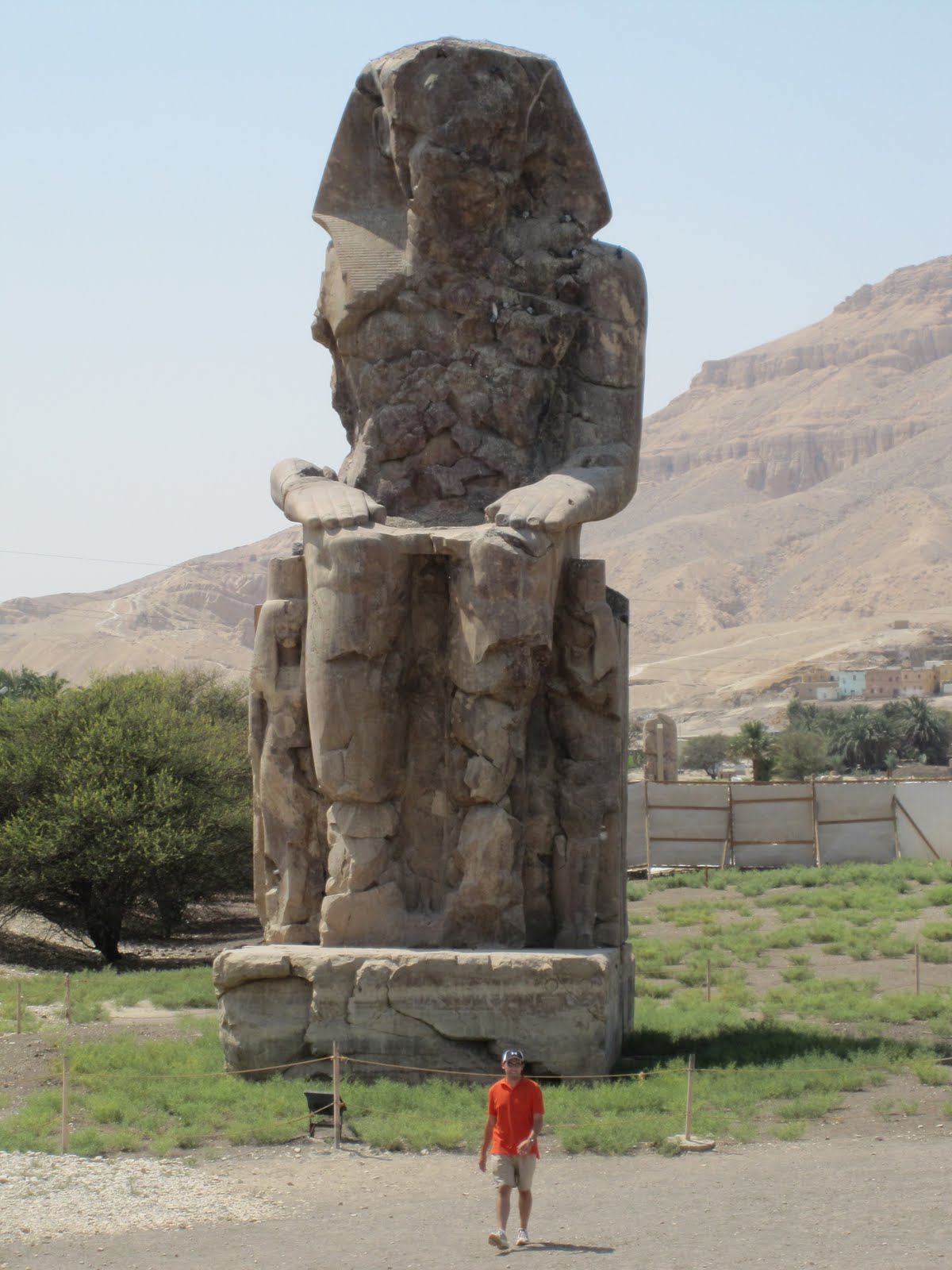
Our last stop was the Colossi of Memnon (two big statutes known in ancient Greek times for haunting voices at dawn, the result of moisture in the cracks of the statues and heavy wind).

Colossi of Memnon.


It was an incredible day of sightseeing in Luxor! And we have a great Egyptologist – he used to dig in the sites, is up to date on all the newest developments in the study of Egyptology, and obviously has a passion for teaching guests in Egypt. My one complaint is that we didn’t have more time at each site! He was always telling us to “shake a leg!”

Back on the boat we had a cocktail hour and dinner, followed by a belly dancing and whirling dervish show. Our tour group is a fun little group of six – two girl friends from NYC, a mother and daughter, and Paul and me. We had fun chatting over cocktails, and everyone told me Paul’s dancing skills were quite impressive when the belly dancer pulled him up on “center stage!”

Paul dancing. I have an AWESOME video of Paul belly dancing, but sadly I cannot get it to upload here!

Colorful whirling dervish.

Day 15: Memphis and The Pyramids

We headed out early in the morning to visit, Memphis, Egypt’s ancient capital city. There was not a lot to see, as the stones from the Memphis were long ago removed and taken to build monuments in Cairo. The biggest draw for visiting Memphis was a MASSIVE statute of Ramses II. The size was overwhelming, and it was amazing to see (on closer inspection after we stopped marveling at the size of the statue) the detail in the facial features, hands and fingers, knees and leg muscles.
We had to stand on the second story of a building constructed around the statue of Ramses II to get the full view!
Little me next to big Ramses II.

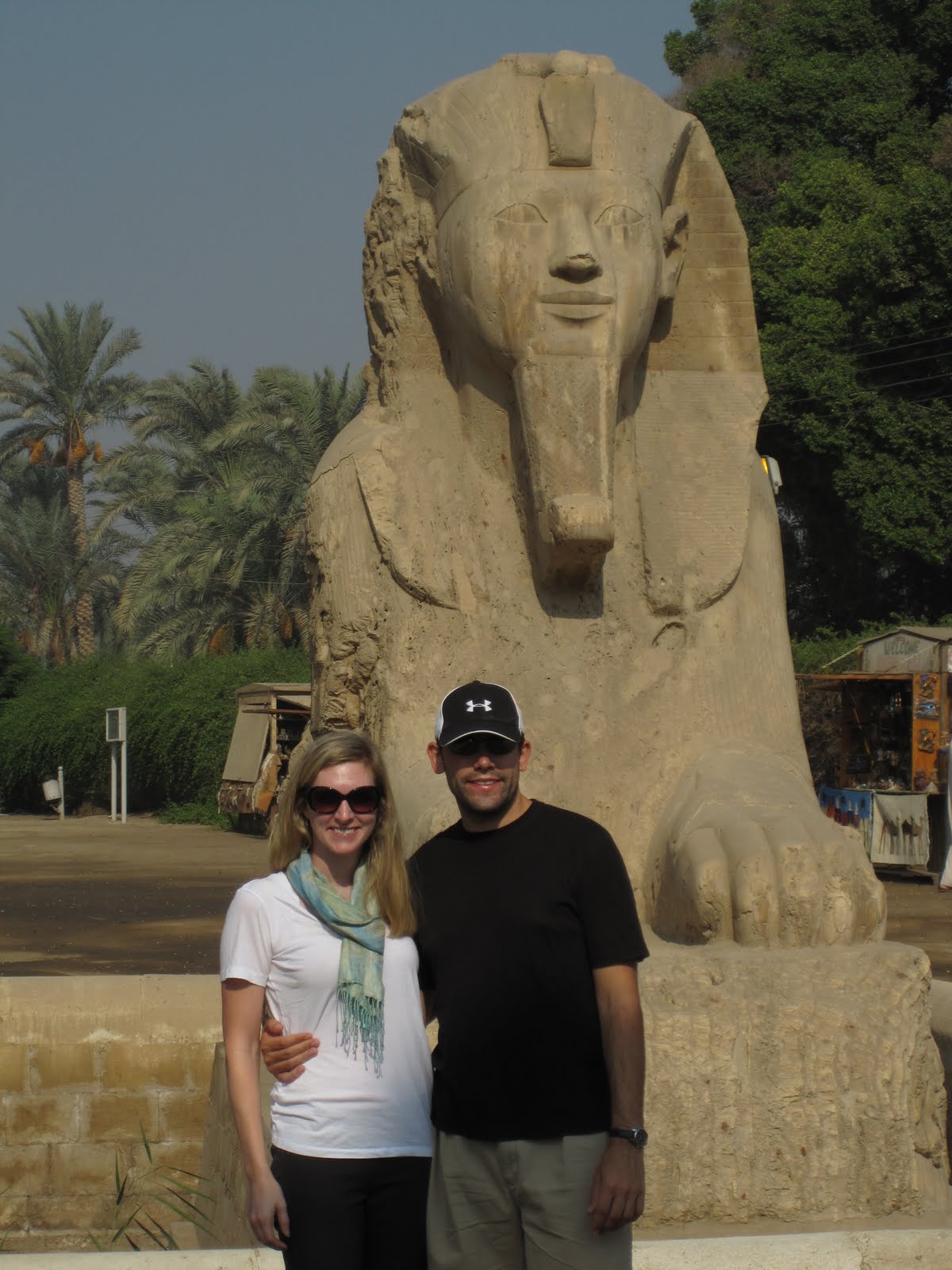
Photo op at a sphinx discovered at Memphis.
I thought this statue, discovered at Memphis, was tall...until we saw the statue of Ramses II.

Our second stop was Sakkara, the location of the oldest pyramid in Egypt, the famous “step pyramid” constructed for King Zoser. It was built by Imhotep, an engineer, doctor, and general genius that was so smart he was eventually worshipped as a god! We entered the site through a long columned corridor built to look like a palace, for King Zoser to use in the afterlife, walked out onto an open courtyard, and stared up at the ancient pyramid. At the edge of the courtyard opposite the step pyramid we looked down into a 90 ft. hole where King Zoser’s organs were buried. It was an interesting site to see and explore. And the first pyramid we saw in Egypt!


Paul exploring the other ruins at Sakkara.

On our way from Sakkara to the Great Pyramids of Cairo, we stopped by a carpet school. Our guide explained that the government set up several carpet schools in the area of Sakkara during the last 50 years as a way to promote the education of local children. Villagers were reluctant to permit schooling for fear that, once educated, the children would move away from the village to the city. The carpet schools were set up to teach kids to read and write, and at the same time, a “handiwork skill” that would keep the kids in the village and increase income. To be honest, it looked a little like a sweatshop. A lot of cute little kids sitting in front of massive looms tying knots so fast that all we saw was a blur of little hands. Paul asked all sorts of questions, like the number of hours per day the kids work, commission, etc. I guess we got satisfactory answers. The carpets were gorgeous, but at over $2000 we decided a souvenir carpet was not meant to be. Someday.

Our final stop of the day were the Great Pyramids of Giza. It was amazing to see the size of the massive pyramids in person. We even got to climb part way up the “greatest” Great Pyramid – the big pyramid made for King Cheops. We bought tickets to enter one of the pyramids (the “second greatest” aka the second biggest) and hunched over as we walked down a steep narrow hall to the center. I don’t recommend it for the claustrophobic! Pyramids are solid stone structures except for the hall to the burial chamber and the burial chamber itself, so it was a quick visit in and out. I thought the most impressive of the sites in Giza was the Sphinx. He was massive and carved from a single block of stone estimated to weight several hundred of tons! The Sphinx’s nose is missing and our guide explained that early Christians and Muslims likely defaced the monument in an effort to exterminate heathen beliefs.
Pyramid of King Cheops (the biggest).

Me climbing the pyramid.
Paul climbing the massive rocks of King Cheops' pyramid.
Us in front of the "second greatest" pyramid, built for King Cheops' son. We later explored the inside.
Us in front of the three Great Pyramids of Giza.
Us with the sphinx and pyramids.


After our visit to the Great Pyramids, we had lunch at a hotel called the Mena House. It was a site in itself! The Mena House was originally constructed as a palace to house the foreign dignitaries that were visiting for the opening of the Suez Canal. It was gorgeous. And we ate lunch in a pretty restaurant with big windows that looked out on the Great Pyramids.
Windows at the Meno House that look out on the Great Pyramids.
Paul enjoying lunch at the Mena House.

After all the sites of the day we were exhausted and spent a nice, boring evening not exploring.

Thursday, September 2, 2010

Day 14: Islamic Cairo and the Cairo Museum

We met our Egyptologist guide in the morning and headed out for a day in Islamic Cairo and the Egyptian Museum.

Our first stop was the Citadel. The highlight was the enormous mosque of Mohammed Ali. In the courtyard outside the mosque, there is a big clock tower that has never worked. Our guide explained the pretty, yet non-functional clock was a gift from the French in exchange for the Egyptian obelisk I have seen standing in the center of Paris. Also, the courtyard of the mosque has an elaborate fountain in the center that Muslims were required to use for purification before entering the mosque. The mosque is still a working mosque, although the fountain is no longer in use.

Me in front of the clock tower.
Paul in front of the fountain.

The inside of the mosque is beautiful. It has several tall domed ceilings, lights everywhere, and a several ton chandelier hanging from the center of the ceiling. Our guide showed us a niche in the wall, always included in the architecture of mosques to indicate the direction of Mecca, and the pulpit where at 12:00 on Friday afternoon, the Muslim priest will deliver his sermon. I was so interesting to see the inside of the beautiful mosque.


The inside of the mosque - hard to capture in a photo!

Next we went over to the Egyptian museum. I LOVED it and was reminded of my childhood obsession with Egypt. Our guide was excellent. He was obviously well educated and knew of all the newest developments in the study of Egyptology. For example, the mummy of the most famous woman pharaoh, Hatshepsut, was just identified in the Egypt museum by DNA testing and matching a tooth discovered in her tomb with her previously unidentified mummy. Prior to the identification, she was referred to as an “obese woman with bad teeth.” We saw her mummified corpse and the old caption in the mummy room.

The mummy room was interesting and creepy at the same time. I was surprised to see hair and teeth and fingers and nails. The mummy of Ramses II, one of the longest ruling pharaohs in Egypt’s history, had particularly distinctive yellowed white hair. We saw animal mummies too, including a giant crocodile and a woman buried with her mummified “pet baboon.”

We spent a lot of time in the King Tut exhibit, which spans two big hallways and a room in the museum. Of course we saw his famous golden mask. I thought one of the most impressive of King Tut discoveries was his solid gold sarcophagus and another larger wooden sarcophagus covered in gold sheet and inlaid glass. The colors and detail in the carvings were beautiful. Paul liked King Tut’s throne the most. It was intricately carved with winged arms and lion paw feet. And the foot rest depicted the enemies of Egypt to show that the pharaoh had his enemies under his control. The endless supply of jewelry, flip flops, and walking sticks were so interesting to see too!

We spent 2 ½ hours in the Egyptian museum, learning the stories of the Egyptian gods and the history of the Egyptian people. Sadly we weren’t allowed to take pictures.

Our final stop was Kahn El-Khalili Bazaar. We stopped for lunch at Naguib Mahfouz, a great little restaurant inside the bazaar, and had traditional Egyptian food. After lunch, we had a few minutes to explore the bazaar (we requested to stay just long enough for our driver to get the car and pick us up, as we dislike bazaar style shopping). We walked quickly through the streets of the bazaar and after a few minutes decided to just wait in the square outside. We weren’t interested in bargaining or buying and wanted a break from the constant yammer of shopkeepers trying to sell. We ran into our guide by the square, and as we waited with him for our driver, a man tried to sell us wallets. He was the worst! He refused to leave, even after our guide politely told him in Arabic that no one wanted to buy his wallets. We tried to ignore him, but he kept shoving a wallet in my face and holding a flame under it (I was familiar with this way of showing the quality of the leather from my time in Florence). Finally, I turned to him and quietly said “MEESH EYE-ZUH!” – a phrase Lindsay taught me that means “I DON’T WANT!” It worked! He slunk away immediately after that. Lindsay told me it was one of the most useful Arabic phrases to know in Egypt, and I was happy to know it after our experience with the persistent wallet man!

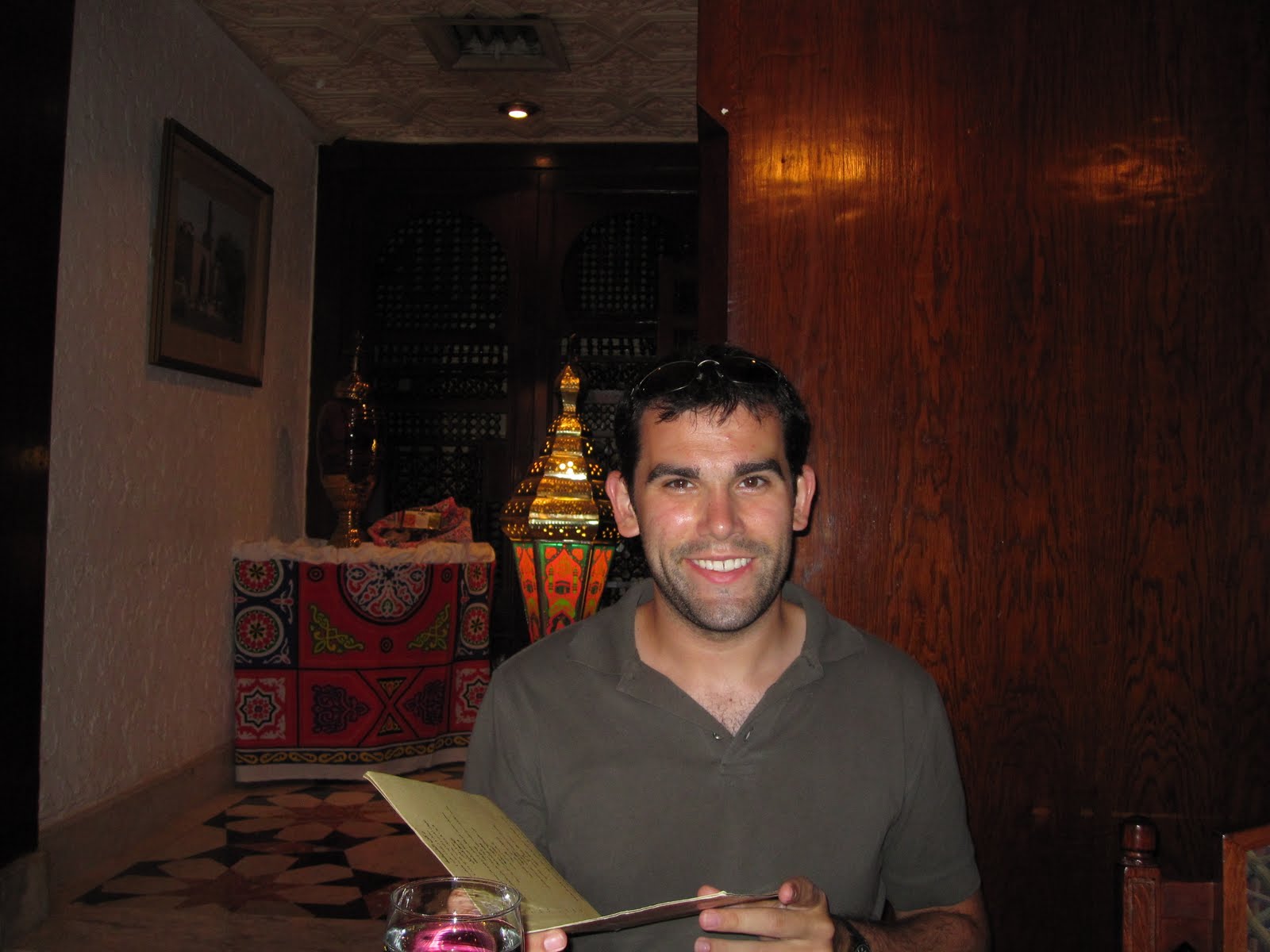
Paul checking out the menu in our lunch spot.

Me at the outskirts of the bazaar.

We had a big lunch and weren’t interested in big dinner, so we wandered off to find a small café (Café Tabasco) that Lindsay had recommended near the American University in Cairo dorms. Again, we were so averse to taking the cabs of Cairo, we decided that the long walk from one end of Zamalek to the other was the preferable course of action. We had looked at Google Maps before we left and knew vaguely the direction we were supposed to head, and by some miracle we found the café! But by that time we decided we actually weren’t hungry at all, so instead of stopping for dinner, we further tested our luck with directions and set off in search of Lindsay’s favorite shisha spot. I knew it was “near” Café Tobasco and after walking aimlessly for a while, we stumbled upon a little outdoor spot with lots of trees that I recognized from Lindsay’s Egypt pictures. It was Café du Paris – Lindsay’s spot! It had a great atmosphere – we loved people watching, especially a big group of study abroad students testing out newly learned Arabic phrases – and it was cheap! We had a lot of fun!

Day 13: Sharm to Cairo

By morning, my burn was feeling a little better and I did not want to leave Sharm without snorkeling at least once. We headed out early under a less harsh sun and jumped off the jetty. Paul was just trying to take care of me and keep me out of the sun the day before when he told me the snorkeling was not as spectacular as in Dahab! I guess he was truthful in saying it was not as “spectacular” – the coral was not as brightly colored and there were less fish – but the fish were different and I would have been sad to miss seeing the Four Seasons’ reef! The most interesting fish I saw was HUGE black fish with a long yellow stripe up top and big orange eyes. I splashed frantically away when I first saw it – it had an open mouth filled with big white teeth! Once I realized it was just eating coral and likely wasn’t hungry for Haases, I swam cautiously back over. Just then another HUGE purple and green fish swam right up to my feet! I was scared all over again, but it was so exciting! I loved seeing the giant fish.

On my way out to snorkel!

After our snorkel, we had a great breakfast of fresh fruit smoothies, omelets and crepes and headed out in the transport Paul had booked through the Four Seasons the day before. Cold towels and waters were waiting for us in the back seat and our luggage was in the trunk by the time we arrived at reception. Our driver even took us into the airport and helped us navigate security, which was quite confusing with e-tickets. Security is set up before the airline ticket counters, and yet security requires tickets for entry. With the help of our driver, we got it all straightened out and were set for our flight to Cairo.

On our way to breakfast - a pretty morning!

The flight was short and easy and on time. We were greeted by our Abercrombie &Kent tour coordinator and driven to our hotel on Zamalek – a long island in the middle of the Nile. It was the first hotel all trip I actually disliked. Despite the excellent trip advisor reviews, the hotel is old, the towels are a bit dingy, the shower is rusty, and the carpet is lumpy. And the hotel staff are not friendly. We have a beautiful view across the Nile, although we look out on the Four Seasons and it calls to me…I guess I got quite spoiled from my 1 day in Sharm! I have my complaints, but I swear I have a little perspective too and know that our hotel is just fine for a 3 night stay in Cairo.


View from our room.

In the evening we headed out to Taboula, a restaurant that Lindsay recommended from her time studying in Cairo. We were a little nervous to venture out into the city on foot, but we were far more unwilling to deal with the hassle of cabs, so we decided to walk. We walked over the bridge from Zamalek and down a few busy streets and a few scary dark streets (that happened to house the US and British Embassies) and made it to Taboula in no time. It was buzzing with all the Muslims there to break the day’s fast, but after a few minutes we were seated. I tried to order a few of the dishes that Lindsay had recommended, and I liked trying to picture her time in Cairo.

On the way back the streets were so busy. I understand the comparison of Cairo to New York – both cities are big and dirty with bright lights and billboards and both cities are ALIVE.


Cairo at Night!